

thesaintnoahVerified buyer
Jun 8, 2026
★★★★★
Exceptional fast shipping and Customer Service
Amazing product, BioInfinity is the only place i am going to use in the future, thanks for the amazing customer service you are providing!
TB-500 is a synthetic 7-amino-acid fragment from thymosin beta-4's actin-binding site. A Phase 1/2 trial launched February 2026 investigates its cardiovascular effects in adults with stable atherosclerotic disease. Phase 1 safety data in 84 healthy volunteers showed favorable tolerability. 2025 research reveals its wound-healing activity may stem from the metabolite Ac-LKKTE rather than the parent compound.
Research status
clinical investigational
Sequence
Ac-LKKTETQ (active fragment of 43-aa Tβ4)
Molecular weight
4963 Da (full Tβ4) / ~900 Da (TB-500 fragment)
Molecular formula
C212H350N56O78S (full Tβ4)
For research use only. This summary is a research-scientific overview compiled from peer-reviewed sources. It is not medical advice and is not intended for human or veterinary consumption.
Related products
Third-Party Tested by Verum Analytics
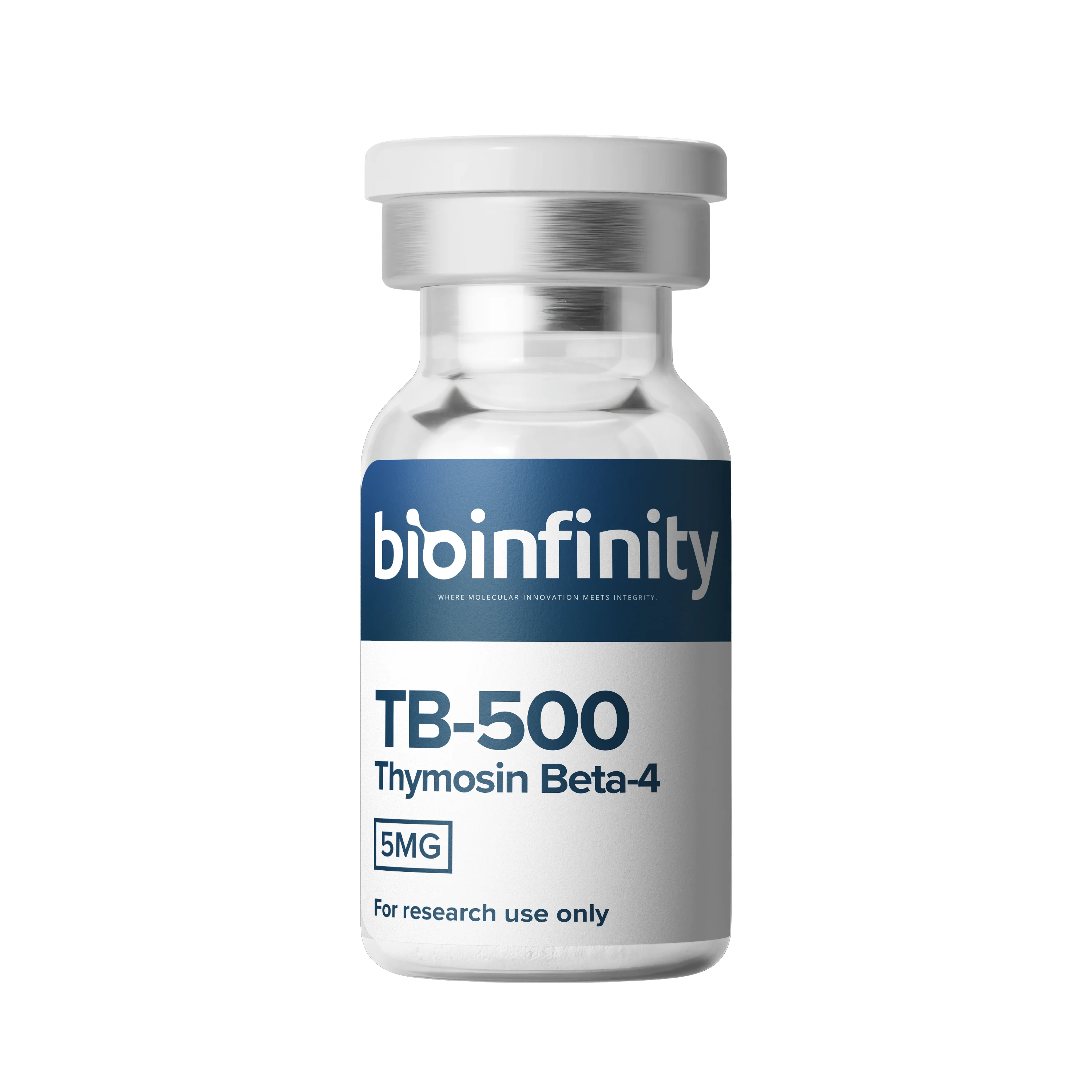
Thymosin Beta-4 fragment — systemic tissue repair, cell migration, and full-body recovery peptide.
Third-Party Tested by Verum Analytics

Albert's Verdict
Thymosin Beta-4's actin-binding mechanism is what makes it exceptional — it drives how tissue reorganizes in wound-model research. The migration data on endothelial cells is some of the most consistent I've reviewed.
View COA✓ In stock - Ships same day
Arrives as lyophilized (powder) form
Shipped freeze-dried for maximum stability and shelf life. See laboratory preparation guide for handling instructions.
Researchers also added
Research profile
A 43-residue peptide (or its Ac-SDKP N-terminal tetrapeptide fragment) characterised as a G-actin-sequestering molecule with published effects on cytoskeletal dynamics and vascular remodelling in preclinical models. For laboratory characterisation only.
Molecular formula
C212H350N56O78S
Mechanism of action
Binding and functional-assay data for TB-500, from peer-reviewed in-vitro pharmacology publications. Values are receptor activity parameters — not clinical outcomes.
G-actin
Monomeric G-actin
Sequesterer (in vitro)
Thymosin β4 is characterised in the primary literature as the principal G-actin-sequestering peptide in mammalian cells, maintaining the monomeric actin pool.
Source: Goldstein et al., Nat Rev Mol Cell Biol 2005
VEGF
VEGF axis
Upregulation (in vitro)
In-vitro endothelial and myocardial models report Tβ4-mediated upregulation of vascular endothelial growth factor, proposed as an angiogenic mechanism.
Source: Bock-Marquette et al., Nature 2004
MMP
Matrix metalloproteinases 2/9
Modulator (in vitro)
Corneal-wound and dermal in-vitro assays describe Tβ4-mediated modulation of MMP-2 and MMP-9, implicated in extracellular matrix remodelling.
Source: Sosne et al., Ann N Y Acad Sci 2010
Receptor EC₅₀ values from in-vitro cAMP functional assays reported in peer-reviewed literature. In-vitro / preclinical characterisation only — no clinical or therapeutic claim is expressed or implied. Research use only.
Study framework
Study designs referencing this compound in the published literature. Descriptions cover framework only — phase, participant count, duration, and citation — not outcomes. Click a card to review the source directly.
Cardiac repair model
In-vitro + murine post-MI cardiomyocyte assays
Bock-Marquette et al., Nature 2004
Corneal-wound model
Rabbit corneal epithelial healing assays
Sosne et al., Exp Eye Res 2002
Structural review
G-actin sequestration mechanism review
Goldstein et al., Nat Rev 2005
Independent COA
≥99% purity · <0.05 EU/mL endotoxin · lot-specific
Freedom Diagnostic (accredited)
Compound comparison
Two peptides frequently studied together in tissue-regeneration research. Reference chemistry only — no comparative-effectiveness claim expressed or implied.
| Compound | Sequence | MW | Half-life (lit.) | Reference |
|---|---|---|---|---|
BPC-157 peptide | 15 residues | 1419.53 g/mol | in-vitro dependent | Sikiric 2018 review |
Thymosin β4 (TB-500 fragment) peptide | 43 residues (full-length Tβ4) | 4964 g/mol (Tβ4) | in-vitro dependent | Goldstein Nat Rev 2005 |
Reference chemistry only. Receptor-binding indications are qualitative (compound engages / does not engage the receptor in in-vitro assays as reported in the cited literature). No comparative-effectiveness claim is expressed or implied.
Cited sources
Independent published research indexed from PubMed and peer-reviewed journals — not BioInfinity claims.
Thymosin beta 4 and cardiac protection: implication in inflammation and fibrosis
2012 · Ann N Y Acad Sci
View source
Thymosin beta-4: a multi-functional regenerative peptide
2007 · Expert Opin Biol Ther
View source
Thymosin beta-4 and the anti-fibrotic effects on the heart
2010 · Ann N Y Acad Sci
View source
For research use only.
Not for human or veterinary use. All data on this page reflects chemistry attributes, in-vitro pharmacology, and study-framework metadata from published peer-reviewed literature. No statement describes or implies any therapeutic effect in humans. These statements have not been evaluated by the FDA; this product is not intended to diagnose, treat, cure, or prevent any disease. Sold exclusively to qualified researchers and institutions.TB-500 (Thymosin Beta-4 Fragment) is a synthetic heptapeptide fragment of thymosin beta-4. TB-500 is a synthetic 7-amino-acid fragment from thymosin beta-4's actin-binding site. A Phase 1/2 trial launched February 2026 investigates its cardiovascular effects in adults with stable atherosclerotic disease. Phase 1 safety data in 84 healthy volunteers showed favorable tolerability. 2025 research reveals its wound-healing activity may stem from the metabolite Ac-LKKTE rather than the parent compound. It has a molecular formula C212H350N56O78S (full Tβ4), mass 4963 Da (full Tβ4) / ~900 Da (TB-500 fragment) Da. Its published amino-acid sequence is Ac-LKKTETQ (active fragment of 43-aa Tβ4). Common synonyms in the literature include Thymosin Beta 4, Tβ4, and TB4.
Investigation of TB-500 (Thymosin Beta-4 Fragment) to date is clinical-investigational, with the majority of citations concentrated in animal models and in-vitro assays rather than randomized controlled human trials. Published work referencing TB-500 (Thymosin Beta-4 Fragment) spans Dermal wound healing models: Phase 2 human trials for stasis and pressure ulcers showed accelerated healing by almost a month in responding patients. Day 4 topical application showed 42% improvement in reepithelialization vs. saline controls, increasing to 61% by day 7. Animal studies demonstrated thicker collagen fiber bundles with reduced wound width and scarring, Cardiac injury research: Human clinical trials explored TB-4's ability to protect and repair cardiac tissue following acute myocardial infarction. In one trial, endothelial progenitor cells combined with TB-4 were transplanted into post-MI patients, showing improved walk time and cardiac function after 6 months. Animal studies indicate TB-4 helps repair heart damage and improves cardiac vasculature, and Musculoskeletal models: Rodent studies have examined TB-500 in muscle injury, tendon healing, and ligament repair contexts. Observations include effects on fibroblast activity, collagen organization, and biomechanical recovery metrics. Proposed mechanisms in the literature include G-actin sequestration: binds G-actin 1:1, inhibits F-actin polymerization, modulates actin structures in hypoxic cardiac cells and ROCK1/MRTFA pathway: decreases ROCK1 protein, reduces profibrotic signaling via MRTFA/SRF in cardiac cells under hypoxia. None of this material describes therapeutic outcomes in humans, and BioInfinity does not sell, market, or provide dosing guidance for TB-500 (Thymosin Beta-4 Fragment) outside laboratory research.
Lyophilized TB-500 (Thymosin Beta-4 Fragment) arrives as a fluffy off-white solid inside a sealed sterile vial. Because it ships as a lyophilized peptide (4963 Da (full Tβ4) / ~900 Da (TB-500 fragment) Da), the powder is best stored between 2–8 °C prior to reconstitution and returned to −20 °C in aliquots for long-term storage post-reconstitution. Reconstitution is typically performed with bacteriostatic water (0.9 % benzyl alcohol preserved) rather than sterile water because the preservative extends solution stability once the vial has been punctured. Warming the reconstituted solution to room temperature before drawing helps redissolve any peptide that has settled against the vial wall. Avoid repeated freeze–thaw cycles: for peptides in this molecular-weight range (4963 Da (full Tβ4) / ~900 Da (TB-500 fragment) Da), freeze–thaw stress is one of the most common causes of loss-of-purity between batches.
Every batch of TB-500 (Thymosin Beta-4 Fragment) ships with a batch-specific Certificate of Analysis produced by an ISO-accredited third-party analytical laboratory. Reversed-phase HPLC confirms the assay against the expected 4963 Da (full Tβ4) / ~900 Da (TB-500 fragment) Da mass (C212H350N56O78S (full Tβ4)); mass spectrometry validates the exact monoisotopic mass; endotoxin (LAL) testing confirms bacterial-contamination limits appropriate for laboratory research; and residual-solvent panels confirm the manufacturing pipeline. The lot number on the outer label matches the COA on the public /coa-library page — every purity claim is independently verifiable before you open the vial.
For the full mechanistic profile, published references, and constraint notes on TB-500 (Thymosin Beta-4 Fragment), see the TB-500 (Thymosin Beta-4 Fragment) research page. All references cited on that page are peer-reviewed primary literature.
Research use only. TB-500 is sold strictly for in-vitro and animal research. It is not a drug, food, supplement, or cosmetic and is not intended for human or veterinary consumption. No statements on this page describe or imply any therapeutic effect.
TB-500 is a synthetic version of Thymosin Beta-4, a naturally occurring 43-amino acid peptide found in high concentrations in blood platelets, wound fluid, and other tissues. Thymosin Beta-4 was originally isolated from thymus extracts in the 1960s and has since been identified as a major actin-sequestering protein with significant roles in cell migration, differentiation, and cellular pathway. TB-500 represents a truncated, active region of the full Thymosin Beta-4 molecule, making it more practical for research applications while retaining the key biological activity associated with the parent molecule.
TB-500's biological effects stem from several well-characterized mechanisms that have been studied extensively in laboratory and preclinical settings:
Actin Sequestration: TB-500's primary function involves binding to G-actin (monomeric actin), preventing its polymerization into F-actin filaments. This regulation of actin dynamics is crucial for cell motility and morphological changes during cellular pathway.
Cell Migration Promotion: By modulating the actin cytoskeleton, TB-500 promotes cell migration—a critical process in wound-model research, angiogenesis, and cellular-pathway research. Research shows enhanced migration of endothelial cells, keratinocytes, and other cell types.
Angiogenesis Stimulation: Studies demonstrate TB-500's ability to promote new blood vessel formation. This involves upregulation of VEGF and other angiogenic factors, along with direct effects on endothelial cell proliferation and migration.
Inflammatory Pathway Research: Research indicates TB-500 may modulate cytokine expression and inflammatory cell activity in laboratory studies. Studies show altered expression of inflammatory markers in various experimental models.
Stem Cell Recruitment: Some research suggests TB-500 may influence the mobilization and differentiation of stem and progenitor cells, potentially contributing to its observed cellular-pathway effects.
TB-500/Thymosin Beta-4 has been extensively studied in cardiac research. Studies in animal models of myocardial infarction have shown reduced scar formation, improved cardiac function, and enhanced survival of cardiomyocytes. Clinical trials have explored its potential in cardiac cellular-pathway research following heart attack.
Significant research has focused on TB-500's effects on corneal healing. Studies demonstrate accelerated corneal wound closure, reduced inflammation, and improved outcomes in various corneal injury models. This research led to clinical development of Thymosin Beta-4-based eye drops.
Research has examined TB-500's effects on skin wounds, including burns, incisions, and chronic wounds. Studies report accelerated wound closure, enhanced epithelialization, improved collagen organization, and reduced scarring in various experimental models.
Preclinical studies have investigated TB-500's effects on muscle, tendon, and ligament injuries. Research shows potential benefits for muscle strain recovery, tendon healing, and joint health, with observations of reduced inflammation and accelerated cellular pathway.
| Molecular Formula | C₂₁₂H₃₅₀N₅₆O₇₈S |
| Molecular Weight | 4963.44 g/mol |
| Sequence | Ac-SDKPDMAEIIEKFDKSKLKKTETQEKNPLPSKETIEQEKQAGES (43 AA) |
| Purity | ≥99% (HPLC verified) |
| Form | Lyophilized powder |
| Appearance | White to off-white powder |
| Solubility | Soluble in water, bacteriostatic water |
| Storage | 2–8°C refrigerated (normal). Long-term: −20°C lyophilized. |
TB-500 is a synthetic peptide based on Thymosin Beta-4, a naturally occurring protein involved in cell migration and cellular pathway research. It consists of 43 amino acids and has been studied for its potential healing and cellular-pathway properties.
Explore our comprehensive research guides for detailed information on peptide handling, storage, and research protocols.
Verified research purchases
Been searching for a reliable supplier for months. The purity is legit - you can verify it yourself on the lab's website. Shipped fast and arrived cold. Will definitely reorder.
This is my go-to source now. Consistent quality every time, and the customer service actually responds when you have questions. The quantity discounts are a nice bonus too.
After trying 3 different suppliers, this one stands out. The COA is verifiable, shipping is fast, and the product quality speaks for itself. Highly recommend.
Ordered before 2PM and it shipped the same day. Package arrived in perfect condition with ice packs still frozen. That's how it should be done.
You get what you pay for. The third-party testing and COA verification gives me confidence. Already placed my second order.
Love that I can verify the COA directly on Verum's website. The full analytical report with HPLC chromatogram checked out. This level of transparency is rare.
Proper packaging, cold shipping, and everything documented. You can tell they take quality seriously. Already recommended to friends.
Commonly studied alongside in laboratory settings
Frequently asked questions about this compound for laboratory researchers.
Peer-reviewed literature relevant to TB-500 research. Linked PubMed IDs open the original source.
1 verified buyer
Amazing product, BioInfinity is the only place i am going to use in the future, thanks for the amazing customer service you are providing!
Reviews are submitted by verified buyers via per-order tokenized links. Reviews are evaluated for product-focused content; any review containing therapeutic claims (cured, treats, healed, etc.) may be edited or hidden to maintain compliance with FDA and platform guidelines.
Research Use Only: This product is intended for laboratory research purposes only. Not for human consumption.