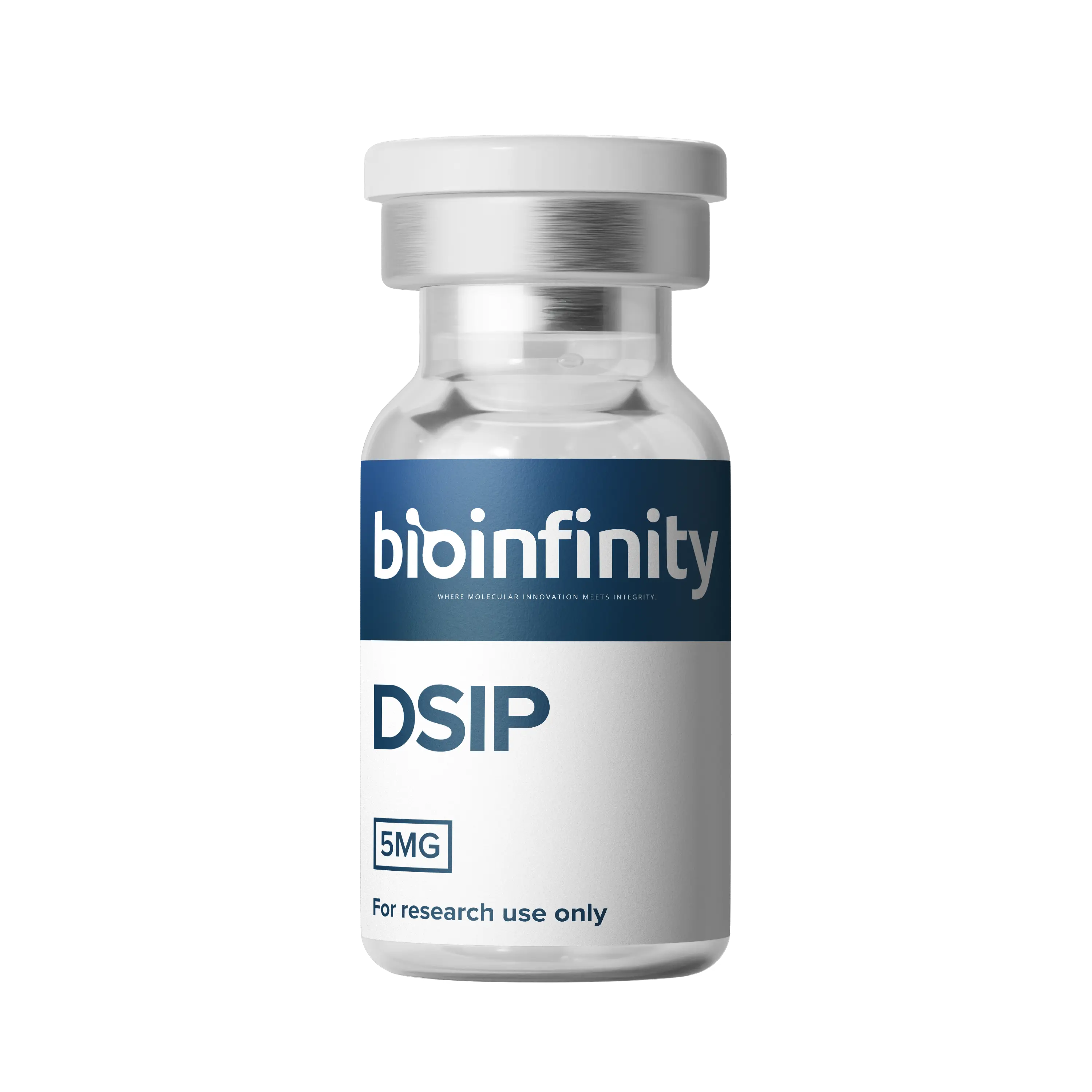
Research summary
DSIP — clinical & mechanistic profile
DSIP is a naturally occurring nonapeptide discovered in 1974 that promotes delta wave sleep, reduces stress, and modulates multiple neurotransmitter systems including GABA and endogenous opioids.
Research status
preclinical
Sequence
Trp-Ala-Gly-Gly-Asp-Ala-Ser-Gly-Glu
Molecular weight
848.8 g/mol
Molecular formula
C35H48N10O15
Studied applications
- •Promotes delta wave (deep) sleep without sedation
- •Reduces sleep latency and nocturnal awakenings
- •Modulates cortisol and stress response
- •No tolerance or dependence reported
Mechanisms of action
- •GABA system enhancement
- •NMDA receptor interaction
- •Endogenous opioid system modulation
- •Hypothalamic-pituitary-adrenal axis regulation
Research constraints & safety notes
- •Limited human clinical data
- •Very short half-life (~8 minutes)
- •Limited stability - degrades quickly
- •Research primarily from Soviet-era studies
Peer-reviewed references
- Graf et al. — DSIP pharmacokinetics and sleep studies
- Schneider-Helmert & Schoenenberger — DSIP clinical trials in insomnia (1983)
- Kovalzon & Strekalova — DSIP as sleep-promoting peptide: 50 years of research (2024)
For research use only. This summary is a research-scientific overview compiled from peer-reviewed sources. It is not medical advice and is not intended for human or veterinary consumption.