

Joshua E.Verified buyer
Jun 20, 2026
★★★★★
Pure and fast
Works as intended!
Epithalon is a synthetic tetrapeptide (AEDG) that activates telomerase via hTERT upregulation. A September 2025 Biogerontology study confirmed dose-dependent telomere extension in normal epithelial, fibroblast, and cancer cell lines. Brunel University (2025) independently replicated telomere lengthening across cell types. Additional 2025 data shows it restores antioxidant genes (SOD2, catalase, HO-1) and prevents DNA hypomethylation in hyperglycemic retinal cells.
Research status
preclinical
Sequence
Ala-Glu-Asp-Gly
Molecular weight
390.35 Da
Molecular formula
C14H22N4O9
For research use only. This summary is a research-scientific overview compiled from peer-reviewed sources. It is not medical advice and is not intended for human or veterinary consumption.
Related products
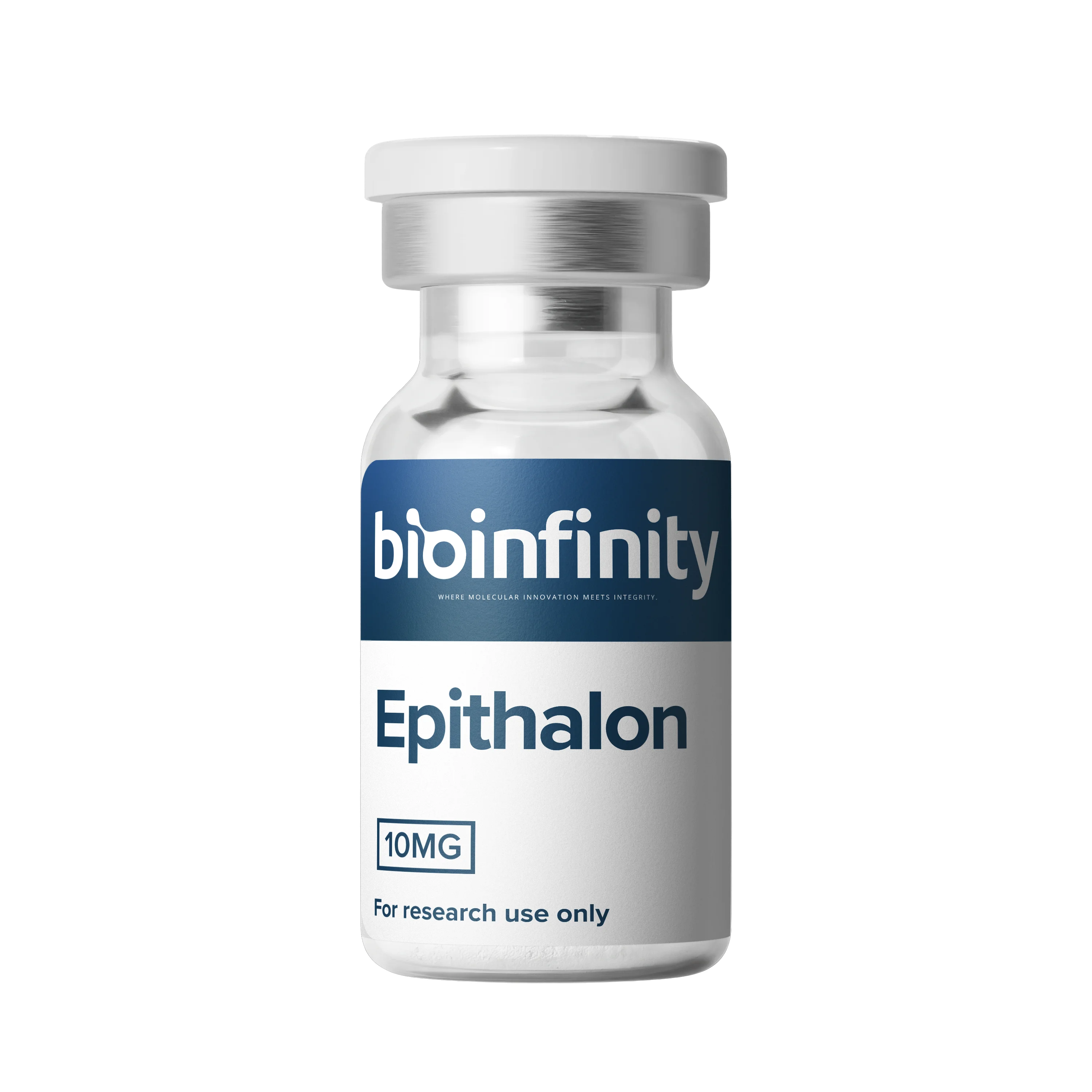
Third-Party Tested by Verum Analytics
AEDG tetrapeptide (Epitalon) — the most-researched telomerase activator for longevity and senescence-focused.
Third-Party Tested by Verum Analytics

Albert's Verdict
Epithalon's telomerase activation data is what puts it in a category of its own for cellular-aging research. The pineal gland regulation angle adds another layer — this tetrapeptide has more research depth than most compounds three times its size.
View COAArrives as lyophilized (powder) form
Shipped freeze-dried for maximum stability and shelf life. See laboratory preparation guide for handling instructions.
Researchers also added
Research profile
A synthetic 4-residue peptide (Ala-Glu-Asp-Gly) characterised in the primary literature by the Khavinson group as a modulator of telomerase activity and pineal-gland gene expression in preclinical models. For laboratory characterisation only.
Molecular formula
C14H22N4O9
Mechanism of action
Binding and functional-assay data for Epithalon (Epitalon), from peer-reviewed in-vitro pharmacology publications. Values are receptor activity parameters — not clinical outcomes.
TERT
Telomerase reverse transcriptase
Activator (in vitro)
In-vitro human fibroblast cultures report increased TERT expression and telomerase activity following epitalon exposure, sustained over multiple passages.
Source: Khavinson et al., Bull Exp Biol Med 2003
PIN
Pineal melatonin pathway
Modulator (in vitro)
Preclinical rodent studies describe epitalon-mediated normalisation of pineal melatonin rhythms, most pronounced in aged animals.
Source: Anisimov et al., Neuroendocrinol Lett 2003
Receptor EC₅₀ values from in-vitro cAMP functional assays reported in peer-reviewed literature. In-vitro / preclinical characterisation only — no clinical or therapeutic claim is expressed or implied. Research use only.
Study framework
Study designs referencing this compound in the published literature. Descriptions cover framework only — phase, participant count, duration, and citation — not outcomes. Click a card to review the source directly.
Telomere length study
In-vitro human fibroblast passages · TERT expression
Khavinson et al., Bull Exp Biol Med 2003
Preclinical geroprotection
Rodent lifespan + tumour-incidence study
Anisimov et al., Ann N Y Acad Sci 2003
Pineal function review
Comparative review of pineal-derived peptides
Khavinson et al., Neuroendocrinol Lett 2002
Independent COA
≥99% purity · <0.05 EU/mL endotoxin · lot-specific
Freedom Diagnostic (accredited)
Cited sources
Independent published research indexed from PubMed and peer-reviewed journals — not BioInfinity claims.
Epithalon and telomerase activity in human somatic cells
2007 · Bull Exp Biol Med
View source
Effect of Epithalamin and Epithalon on cell proliferation and apoptosis
2002 · Bull Exp Biol Med
View source
Peptide Epithalon and pineal gland function in aging research
2003 · Neuro Endocrinol Lett
View source
For research use only.
Not for human or veterinary use. All data on this page reflects chemistry attributes, in-vitro pharmacology, and study-framework metadata from published peer-reviewed literature. No statement describes or implies any therapeutic effect in humans. These statements have not been evaluated by the FDA; this product is not intended to diagnose, treat, cure, or prevent any disease. Sold exclusively to qualified researchers and institutions.Epithalon (Epitalon) is a synthetic tetrapeptide (4 amino acids). Epithalon is a synthetic tetrapeptide (AEDG) that activates telomerase via hTERT upregulation. A September 2025 Biogerontology study confirmed dose-dependent telomere extension in normal epithelial, fibroblast, and cancer cell lines. Brunel University (2025) independently replicated telomere lengthening across cell types. Additional 2025 data shows it restores antioxidant genes (SOD2, catalase, HO-1) and prevents DNA hypomethylation in hyperglycemic retinal cells. It has a molecular formula C14H22N4O9, mass 390.35 Da. Its published amino-acid sequence is Ala-Glu-Asp-Gly. Common synonyms in the literature include Epitalon, Epithalone, and AEDG peptide.
Investigation of Epithalon (Epitalon) to date is primarily preclinical, with the majority of citations concentrated in animal models and in-vitro assays rather than randomized controlled human trials. Published work referencing Epithalon (Epitalon) spans Human cell culture studies: Research in human fetal lung fibroblasts, epithelial cells (HMEC, IBR.3), and lymphocytes has examined Epithalon's effects on telomerase activity and telomere length. Studies using the TRAP (Telomere Repeat Amplification Protocol) assay reported telomere extensions up to 33.3% on average in some lymphocyte studies, Telomerase gene expression: Experiments showed Epithalon upregulates hTERT (the catalytic subunit of telomerase) mRNA expression, with effects occurring primarily during the G1 phase of the cell cycle. The peptide reportedly enters cell nuclei and binds to promoter regions containing ATTTC motifs, and Cancer cell comparisons: In cancer cell lines (21NT, BT474, HeLa), Epithalon was observed to extend telomeres primarily through the ALT (Alternative Lengthening of Telomeres) pathway rather than telomerase activation, suggesting selectivity for healthy cells. This selectivity has been proposed as a safety feature. Proposed mechanisms in the literature include hTERT upregulation: increases telomerase catalytic subunit mRNA expression primarily during G1 cell cycle phase and Chromatin modification: enters cell nuclei, binds promoter regions (ATTTC motifs) for epigenetic activation. None of this material describes therapeutic outcomes in humans, and BioInfinity does not sell, market, or provide dosing guidance for Epithalon (Epitalon) outside laboratory research.
Lyophilized Epithalon (Epitalon) arrives as a fluffy off-white solid inside a sealed sterile vial. Because it ships as a lyophilized peptide (390.35 Da), the powder is best stored between 2–8 °C prior to reconstitution and returned to −20 °C in aliquots for long-term storage post-reconstitution. Reconstitution is typically performed with bacteriostatic water (0.9 % benzyl alcohol preserved) rather than sterile water because the preservative extends solution stability once the vial has been punctured. Warming the reconstituted solution to room temperature before drawing helps redissolve any peptide that has settled against the vial wall. Avoid repeated freeze–thaw cycles: for peptides in this molecular-weight range (390.35 Da), freeze–thaw stress is one of the most common causes of loss-of-purity between batches.
Every batch of Epithalon (Epitalon) ships with a batch-specific Certificate of Analysis produced by an ISO-accredited third-party analytical laboratory. Reversed-phase HPLC confirms the assay against the expected 390.35 Da mass (C14H22N4O9); mass spectrometry validates the exact monoisotopic mass; endotoxin (LAL) testing confirms bacterial-contamination limits appropriate for laboratory research; and residual-solvent panels confirm the manufacturing pipeline. The lot number on the outer label matches the COA on the public /coa-library page — every purity claim is independently verifiable before you open the vial.
For the full mechanistic profile, published references, and constraint notes on Epithalon (Epitalon), see the Epithalon (Epitalon) research page. All references cited on that page are peer-reviewed primary literature.
Research use only. Epithalon (Epitalon) is sold strictly for in-vitro and animal research. It is not a drug, food, supplement, or cosmetic and is not intended for human or veterinary consumption. No statements on this page describe or imply any therapeutic effect.
Verified research purchases
Tried multiple suppliers over the years. BioInfinity's purity is consistently the highest. The verifiable COA gives me confidence in what I'm getting.
High purity is important to me and this delivers. Clean product, professional packaging, fast shipping. Everything you want from a supplier.
Been ordering from BioInfinity for over two years. Never had a quality issue. The consistency is why I keep coming back.
I was worried about international shipping but the package arrived faster than expected and in perfect condition. Ice packs still cold.
After dealing with inconsistent suppliers, finding BioInfinity was a relief. The quality is real and the COA is verifiable. Exactly what I needed.
Love that they include full documentation with every order. The third-party testing gives me confidence in what I'm buying.
Compared prices across multiple suppliers. BioInfinity has the best combination of quality and price. The bulk discounts are a nice bonus.
When you find a good supplier you stick with them. BioInfinity has been consistently excellent across multiple orders. Highly recommend.
Commonly studied alongside in laboratory settings
Frequently asked questions about this compound for laboratory researchers.
Peer-reviewed literature relevant to Epithalon (Epitalon) research. Linked PubMed IDs open the original source.
1 verified buyer
Works as intended!
Reviews are submitted by verified buyers via per-order tokenized links. Reviews are evaluated for product-focused content; any review containing therapeutic claims (cured, treats, healed, etc.) may be edited or hidden to maintain compliance with FDA and platform guidelines.
Research Use Only: This product is intended for laboratory research purposes only. Not for human consumption.