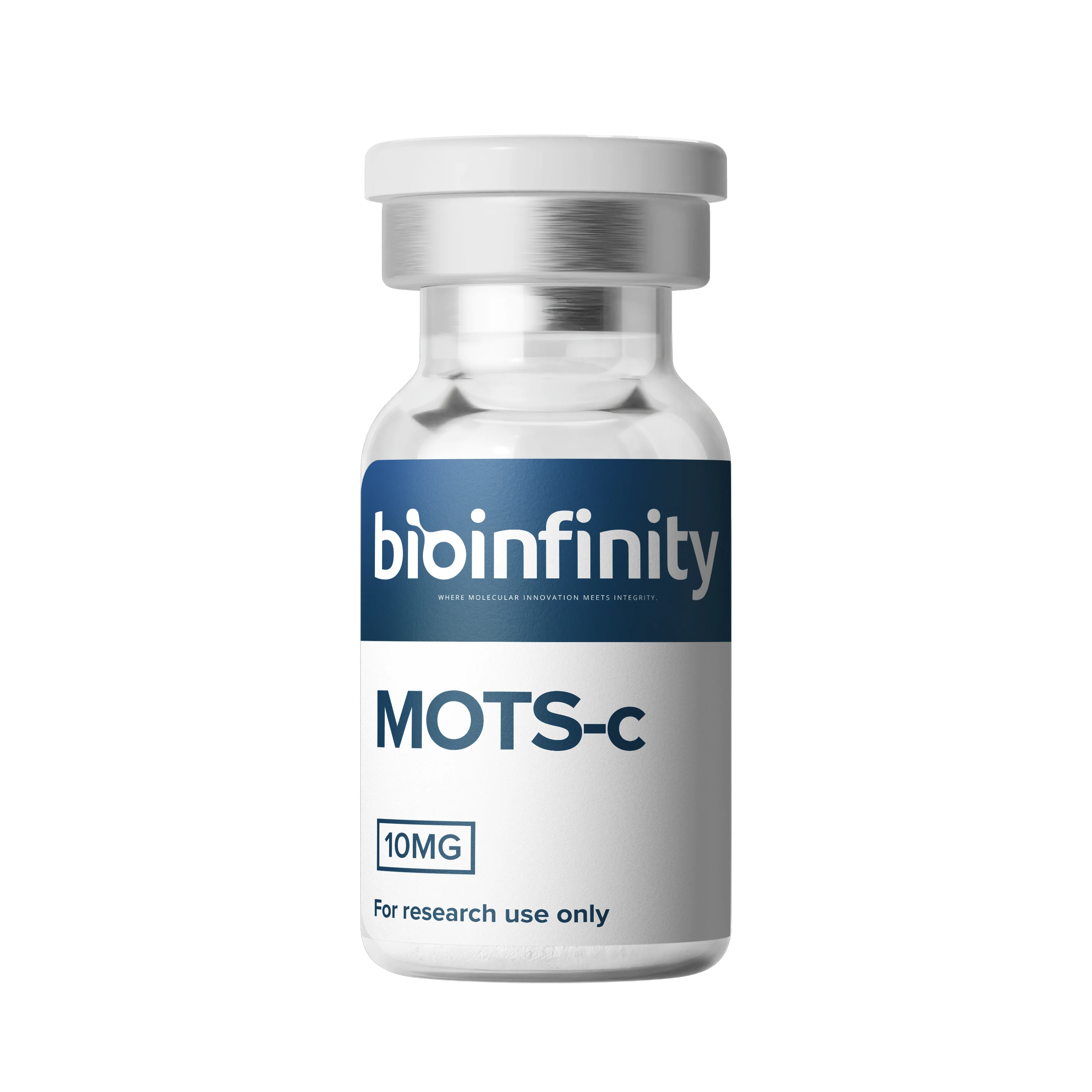
What MOTS-c is
MOTS-c is a 16-amino-acid mitochondrial-derived peptide encoded within the 12S rRNA gene. 2025 studies show it restores cardiac mitochondrial OXPHOS respiration and reduces fasting glucose/hypertrophy in T2D rat models, protects against acute lung injury, and delays weight gain in high-fat diet models. Analog CB411 shows superior stability for obesity/NASH. Levels decline 21% in elderly vs young adults. It has a molecular formula C101H152N28O22S2, mass 2174.64 Da. Its published amino-acid sequence is MRWQEMGYIFYPRKLR. Common synonyms in the literature include Mitochondrial ORF of the 12S rRNA type-c, Mitochondrial-derived peptide MOTS-c, and MDP MOTS-c.
What it's studied for
Investigation of MOTS-c to date is primarily preclinical, with the majority of citations concentrated in animal models and in-vitro assays rather than randomized controlled human trials. Published work referencing MOTS-c spans Metabolic regulation studies: The original 2015 Cell Metabolism paper demonstrated that MOTS-c treatment prevented age-dependent and high-fat diet-induced insulin resistance in mice, reduced body weight, and improved glucose homeostasis through AMPK activation in skeletal muscle. MOTS-c acts as an exercise mimetic, causing cells to behave as if exercise has occurred, Physical performance studies: Mice of all ages treated with MOTS-c showed improvements in endurance, strength, and overall physical capacity. In particular, older mice (equivalent to 65+ in human years) doubled their running capacity on a treadmill compared to untreated controls, even outrunning untreated middle-aged mice. Treatment also improved grip strength, stride length, and balance, and NAD+ and sirtuin research: MOTS-c elevates NAD+ levels and activates sirtuins (particularly SIRT1), metabolic cofactors critical for cell survival and energy metabolism. This represents an important connection to other aging-related pathways. Proposed mechanisms in the literature include AMPK pathway activation: directly activates AMP-activated protein kinase in skeletal muscle, triggering metabolic adaptations and glucose uptake and NAD+/SIRT1 activation: elevates NAD+ levels and activates sirtuins (particularly SIRT1), critical metabolic cofactors for cell survival. None of this material describes therapeutic outcomes in humans, and BioInfinity does not sell, market, or provide dosing guidance for MOTS-c outside laboratory research.
Laboratory handling — storage and reconstitution
Lyophilized MOTS-c arrives as a fluffy off-white solid inside a sealed sterile vial. Because it ships as a lyophilized peptide (2174.64 Da), the powder is best stored between 2–8 °C prior to reconstitution and returned to −20 °C in aliquots for long-term storage post-reconstitution. Reconstitution is typically performed with bacteriostatic water (0.9 % benzyl alcohol preserved) rather than sterile water because the preservative extends solution stability once the vial has been punctured. Warming the reconstituted solution to room temperature before drawing helps redissolve any peptide that has settled against the vial wall. Avoid repeated freeze–thaw cycles: for peptides in this molecular-weight range (2174.64 Da), freeze–thaw stress is one of the most common causes of loss-of-purity between batches.
How this batch is verified
Every batch of MOTS-c ships with a batch-specific Certificate of Analysis produced by an ISO-accredited third-party analytical laboratory. Reversed-phase HPLC confirms the assay against the expected 2174.64 Da mass (C101H152N28O22S2); mass spectrometry validates the exact monoisotopic mass; endotoxin (LAL) testing confirms bacterial-contamination limits appropriate for laboratory research; and residual-solvent panels confirm the manufacturing pipeline. The lot number on the outer label matches the COA on the public /coa-library page — every purity claim is independently verifiable before you open the vial.
Related research
For the full mechanistic profile, published references, and constraint notes on MOTS-c, see the MOTS-c research page. All references cited on that page are peer-reviewed primary literature.
Research use only. MOTS-c is sold strictly for in-vitro and animal research. It is not a drug, food, supplement, or cosmetic and is not intended for human or veterinary consumption. No statements on this page describe or imply any therapeutic effect.